Radiators and Heat Pumps in Cambridge Homes — Sizing, Options and Costs
Last reviewed: 2 October 2026
A worked example shows how an installer decides whether a radiator in a Cambridge terrace is big enough for a heat pump, followed by the options for small rooms and conservation-area homes, and typical costs.
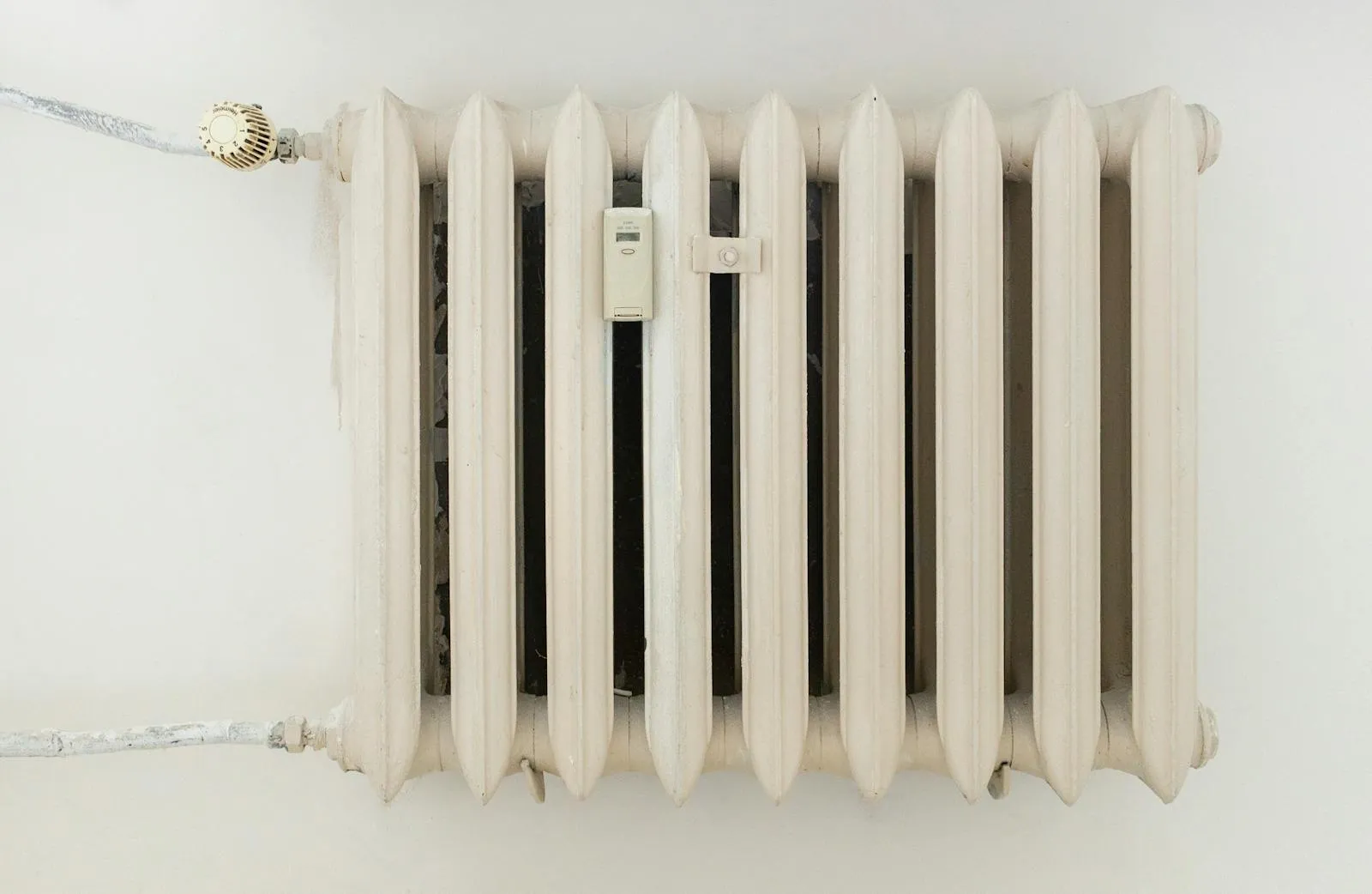
How installers decide
For each room, the installer compares two numbers:
- The room’s heat loss on Cambridge’s cold design day, in watts.
- What the existing radiator can deliver at the planned flow temperature.
If the radiator falls short, it’s upgraded. If it meets or beats the heat loss, it stays.
A worked example: front room in a Romsey terrace
- The room: 3.8 × 3.6 m, 2.7 m ceiling, solid gault-brick front wall with a bay window, suspended timber floor.
- Heat loss on the design day: about 1,500 W.
- Existing radiator: a single-panel radiator labelled 1,800 W.
That label figure assumes the water is about 50°C warmer than the room, typical of a gas boiler. At a 45°C heat pump flow temperature, the radiator is only about 21°C warmer than the room and delivers roughly a third of its label — about 600 W. Well short of 1,500 W.
Options: a double-panel radiator of the same size might deliver around 1,000 W at 45°C — still short. A larger double-panel or a triple-panel radiator, or draught-proofing the bay and floor to cut the heat loss, closes the gap. The installer might also design the system at 50°C, where radiators deliver about 44% of their label figure.
The middle room of the same terrace, sheltered by neighbours on both sides, might keep its radiator unchanged.
Which rooms usually need help in Cambridge
- front rooms with bay windows in Victorian terraces
- rear kitchen extensions with three outside walls and a flat roof
- rooms over unheated passages or garages
- tall-ceilinged rooms in larger villas in De Freville and Newnham
Draughty suspended floors and original sash windows, common across Cambridge’s older streets, add to heat loss. Fixing the draughts can mean fewer radiator upgrades.
Options for small rooms and heritage homes
- Double or triple panel radiators — more heat from the same wall space, useful in compact terraced rooms.
- Column radiators — suit Victorian interiors and give strong output.
- Fan-assisted radiators — boost output where wall space is very limited.
- Keeping original cast iron — in listed homes, original radiators can stay, with a discreet extra emitter added if the room needs more heat.
- Underfloor heating — ideal in an extension being built or refloored anyway.
Costs
Typically £350–£600 per radiator fitted, more for column or fan-assisted models. A Romsey or Petersfield terrace often needs two or three upgrades; a large De Freville or Newnham villa four to six. The grant applies to the whole installation, radiators included.
Pipe sizes and hard water
The surveyor should check whether any pipework is narrow microbore, which can limit flow. Cambridge’s very hard water also leaves scale and sludge in older systems; a thorough system flush and a magnetic filter protect both the new radiators and the heat pump.
Related: flow temperature and design temperature · questions for your heat loss survey
See what a heat pump would look like in your Cambridge home
The mechanism is the same in every UK home; the design is specific to yours. Our team carries out a free in-home survey including a full room-by-room heat-loss calculation, identifies the system size and configuration that fits your property, and provides a written quote with the £7,500 BUS grant already deducted.
You'll see the actual figure you'd pay — not an estimate — and the projected efficiency for your specific install.